By James Brooke – The New York Times – See the article in its original context from – April 26, 1994, Section A, Page 4
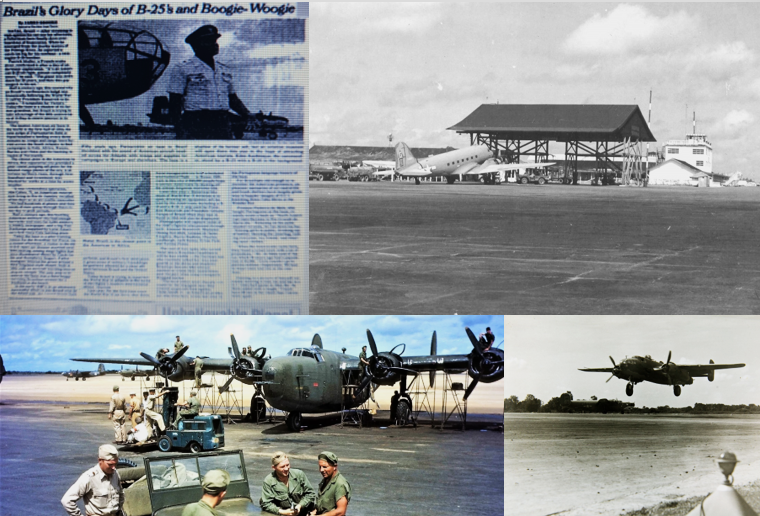
After straining in vain against his net one hot afternoon, a fisherman here finally dove overboard out of frustration. When he emerged from the murky waters of the Potengi River, he reported a catch too big for his rowboat: a twin-engine B-25 bomber.
Patrick Muller, a French scuba diver, confirmed it after a day of underwater exploration. “It’s an American B-25 all right, almost completely intact,” he said. “The plane was down there for 50 years, and then this guy snags it in his net.”
Half a century ago, this coastal city on Brazil’s northeastern bulge was frenetically following the World War II call by President Roosevelt to become a “Trampoline for Victory.” Today the base is a shadow of its former grandeur, but Brazil is trying to take advantage of the 50th anniversary of D-Day to renew interest in its history.
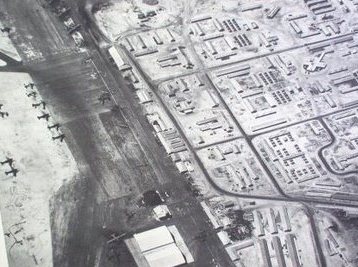
The busiest American air base in the world in the first half of 1944, the twin strips of Parnamirim field at Natal handled a landing every three minutes as troops and cargo were ferried across the South Atlantic to feed campaigns in Italy, Africa, Russia, Burma and China and the looming invasion of Normandy.
The closest point in the Americas to Africa, this equatorial city provided a year-round jumping-off point for the limited-range planes of the era. A alternate northern route, through Newfoundland and Greenland, was blocked for weeks at a time by winter weather.
“It was tremendous operation,” Abe Cohen, 75, an American veteran now living in Rio de Janeiro, recalled of his days as an air-traffic controller. “We had hundreds of planes and thousands of men going through there every day in peak periods.”
Half a century ago, this bustling American military city had enough barracks and tents for 6,600 soldiers, a weekly newspaper, and a big Post Exchange supplied by Latin America’s first Coca-Cola bottling plant.
Today the base is a pilot training center for the Brazilian Air Force. On a recent afternoon, a visitor to the old U.S.O. open-air theater startled swallows nesting among stage lights that once illuminated shows by Clark Gable and Humphrey Bogart. Fallen mangoes littered the grass around a New England-style chapel, built in 1943 with an aircraft warning beacon atop its steeple. The only jeep to be seen on the base was a dune buggy carrying Brazilian airmen for a weekend at the beach.
In the early 1940’s, in an ultimately successful effort to win Brazil over to the Allied side, the United States built airfields and Brazil’s first steel plant. A generation of military friendships forged here allowed for a close alliance between Brazil and the United States.
Today Brazil is trying to resurrect the World War II alliance in the name of the region’s modern international nexus: tourism.
Last year, for the first time since the World War II air ferry shut down, Natal inaugurated its first scheduled international flight — to Rome. Officials in this city of 650,000 people hope to attract Americans by dusting off the almost forgotten wartime link.
Later this year a Historical Museum of World War II Aviation is to open, drawing on equipment left behind by the Americans, including a B-23 and a B-25. A jeep used by President Roosevelt and President Getulio Vargas of Brazil when they met in Natal in 1943 will also be displayed.
Photographs will capture some of the 1940’s figures who passed through here: Eleanor Roosevelt, Madame Chiang Kai-shek, Antoine de Saint-Exupery, Harry Hopkins, Charles Lindbergh, Jack Benny, Ernie Pyle and Tyrone Power.
The cast of Axis spies who turned Natal into a Brazilian Casablanca will be less visible — the German nun who routinely talked her way past guards at the docks and shadowy Brazilian fascists who always seemed to cruise their motorbikes past the port when troop transports dropped anchor.
“The local police were sharply criticized for the negligent way they treated suspected Axis agents,” Clyde Smith Jr., an American professor who lives here, wrote last year in his Portuguese-language history of the base.
For Brazilians old enough to remember the American presence, unpleasant memories of air-raid drills and bomb shelters have largely given way to happier images of G.I.’s knocking down Cuba libres at the Wonder Bar.
“I learned to dance the swing,” Maria Lucia da Costa, now a great-grandmother, recalled as she served homemade cake to an American visitor. “The boogie-woogie was great. The American parties had everything.”
Her husband, Fernando Hippolyto da Costa, a retired Brazilian Air Force colonel, chimed in with a list of American contributions to local culture: “Rayban sunglasses, American cigarettes, canned beer, greased hair, and wearing shorts.”
Protasio Pinheiro de Melo, who taught Portuguese at the base, recently wrote a book on “North American contributions to Rio Grande do Norte life.” Relaxing on his palm-shaded veranda, he ran down his list: “Kissing girls in public, drinking out of bottles, dancing the jitterbug, calling everyone ‘my friend,’ and wearing sport clothes.”
“When the Americans came here, they found a small town with a lot of prejudices,” Mr. de Melo said of Natal, which 50 years ago had a population of 40,000. “Girls couldn’t go to parties without chaperones. We had to wear coats and ties at the cinemas.”
Pointing to a picture of himself solemnly wearing a coat, tie and hat to a G.I. volleyball game in 1943, Mr. de Melo added with a laugh, “I must have 80 ties in the closet that I never wore again.”
A version of this article appears in print on April 26, 1994, Section A, Page 4 of the National edition with the headline: Natal Journal; Brazil’s Glory Days of B-25’s and Boogie-Woogie.
The Brazilian Expeditionary Force (Portuguese: Força Expedicionária Brasileira, or FEB) was the 25,300-man force formed by the Brazilian Navy, Army and Air Force that fought alongside the Allied forces in the Italian Campaign of World War II.
The Brazilian 1st Division of the FEB was under the command of 15th Army Group of Field Marshal Harold Alexander (later General Mark Clark), via the U.S. Fifth Army of Lieutenant General Mark Clark (later Lieutenant General Lucian Truscott) and the US IV Corps of Major General Willis D. Crittenberger.
The Brazilian Air Force component was under the command of XXII Tactical Air Command, which was itself under the Mediterranean Allied Tactical Air Force.
REASON WHY BRAZIL ENTERED IN WW2
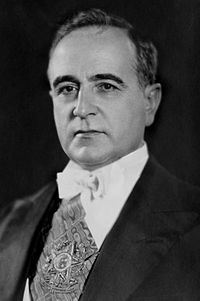
One could argue which was the main reason why Brazil entered the Second World War. In the early 40’s, as a result of the diplomatic actions for the “good vicinity” politics, led by Pres. Roosevelt, fascist – oriented Brazilian strong man, Getúlio Vargas, had to realign his political cores with big brother United States, fighting for Democracy and the Free World.
Getúlio Vargas
Brazil was a very important strategic point for the Allies in the more intense scale of war in Europe and North Africa. Right after Pearl Harbor in 41, Brazil cut relations with Axis countries. Sooner, United States was engaged in the war in Europe and North Africa. All this settled, in a short time there were several air bases in Brazilian land to help the American planes, ships, men and material reach North Africa, in what was called “The Springboard for Victory “. It is said that the American Air base in the city of Recife was one of the busiest in the world at that time.
Natal AFB in World War Two
This base along with another in the city of Natal, helped men, equipment and provisions reach North Africa, since these bases were in the Northeast seashore of Brazil. At the same time, American Army instructors started to train Brazilian troops and supply equipment to Brazilian Army, Navy and Air Force, in the hay days of 1942. With all this privileges to Roosevelt and the war effort of the Allies, the German U Boats that once were routing through the South Atlantic, using bases in Argentina and Chile, started to sink as many merchant ships as they could, being many of this ships with Brazilian flag, in territorial waters. This ragged the public opinion in Brazil so as to force a declaration of war against the Axis on August 42.
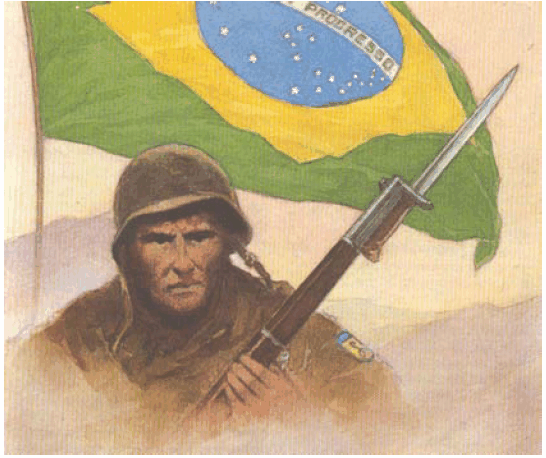
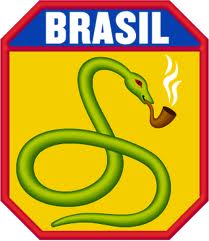
Symbol of FEB
When Brazil – the only country in South America who fought along the Allies – entered WWII, no significant victories of the Allies had occurred at that early stage of the war in the fields of Europe or the Pacific. Soon came the mobilization of men to form the Brazilian Expeditionary Force FEB, in a giant effort to upgrade a backdated army in its doctrine and equipment. It took two years to get these men ready to join the war effort against the Axis forces.
Later in 1944, the Brazilian Forces joined the Allies in Europe to help the actions in Italy, after a gross part of the more experienced troops left for Anzio, South of France and even Normandy. With very few time for proper training, the Brazilian troops compensated with great character and capacity of adaptation to war conditions in a very tough terrain and climate, being well honored by all the staff of the Allied High Command during their participation in the Italian Campaign. Many Brazilian soldiers were condecorated with the highest medals of the American Forces. This has been the finest hour for the Brazilian Expeditionary Force FEB.
THE CAMPAIGN
In the first days of July, 1944, the first Echelon of the Brazilian Expeditionary Force FEB – left to Europe, aboard the American ship General Mann, in a total of 5.081 men. Originally, the ship should be going to Argel, where the troops would get preliminary training before landing in Italian soil. However, the convoy headed straight to Naples, where the troops disembarked and waited to join US Task Force 45. Later, on the 22nd July, two more ships, Gen Mann and Gen Meigs, left to Europe, with the Second and Third Echelons, with 10.369 men total. The last two Echelons, Fourth, with more 4.722 men and Fifth,with 5.128 men, left Brazil on the last days of November and first days of February ’45, totaling 25.300 men.
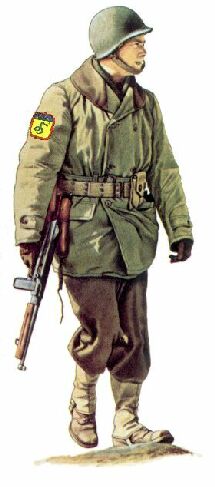
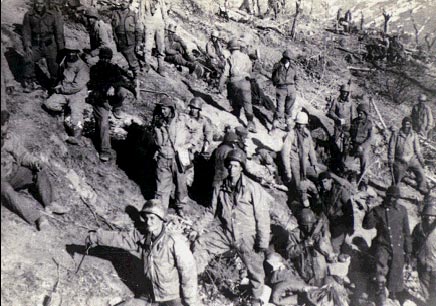
Brazilian soldiers in Italian front
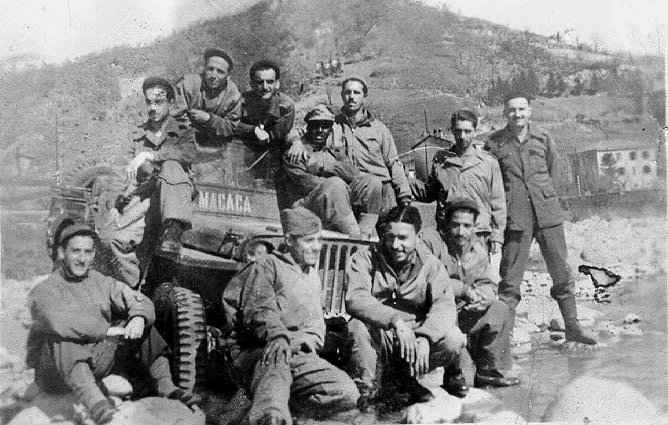
The first moments of the Brazilian troops in Italy were dedicated to acquiring and training with new equipment, since the uniform and gear of the Brazilian Army would not fit the different climate and tough exigencies of a modern war (yes, it was obsolete). So that, all the gear used by the Brazilian Army was the average US G.I. equipment. The troops were moved to Tarquinia, 350 Km North of Naples, where the US 5th Army, commanded by the famous Gen Mark Clark, was based. The Brazilian troops were incorporated to the 4th Army Core, commanded by Gen Crittenberger. On the 19th August, Churchill himself visited the 5th Army in Cecina, where he was told that Brazilian troops were part of the Guard of Honor. He directed some of his speech to the Brazilian troops that now joined the war effort in Italy.
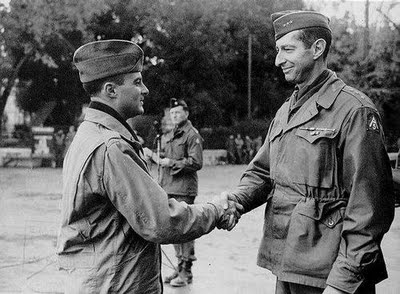
The right is General Mark Clark, commander of the 5th Army and a Brazilian military
The Brazilian troops were filling the gap left by several divisions of the 5th US Army and French Expeditionary Force that went to the invasion in the South of France. This straight action with the fresh Brazilian troops was a necessity, due to the great operation at Anzio, to where so many American and British troops were issued. The overall command of Brazilian troops was made from the High Command of the 15th Allied Army Group, headed by Gen Mark Clark and Gen Crittenberger (5th Army and 4th Army Core, USA), Field marshal Alexander (8th Royal Army, England) together with the high staff of the Brazilian Army, Gen Euríco Dutra, Gen Mascarenhas de Moraes, Gen Zenóbio da Costa and Gen Cordeiro de Farias (commanders of several Infantry and Artillery Divisions among the whole of the Brazilian Expeditionary Force).
On the 16th November, FEB occupied Massarosa. Two days later, Camaiore and other small towns and cities on the way North. During this period, the Brazilians G.I.s, or “pracinhas”, created the FEB symbol, consisting of a badge with a snake over National colors (Green and Yellow), with a smoking pipe in mouth. This was a big irony to answer a group of the society opposing Brazil entering the conflict, who used to say that it was easier to see a snake smoking than to see Brazilian troops sent to fight the war…
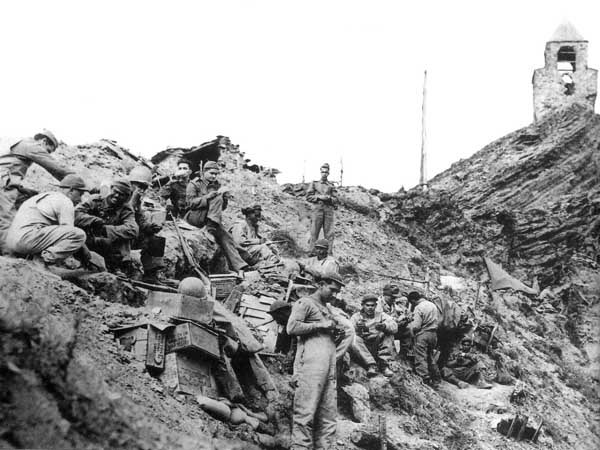
In October, FEB conquered Monte Prano, controlled the Sercchio river valley and Castelnuovo, with first significant losses. Later that month, troops were directed to the Reno valley. This region, at the feet of the Appenines, was the place where FEB would spend the next three months, facing rigorous winter and the fierce resistance of the German forces up on the mountains and hills, the so called Bernhard and Gustav Lines, strong defenses made by the Axis to delay the advance of troops.
Monte Castelo
It was there where one of the great achievements of the Brazilian troops took place: Monte Castelo. In the end of November, several attempts were made to kick the Germans out of this hill, from where they could spot all movements of Allied troops.
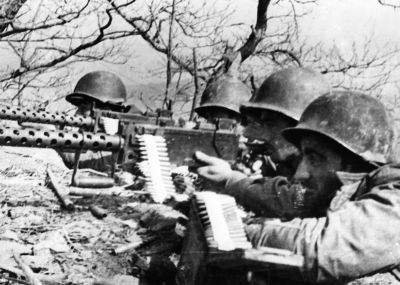
The freshly created and debuting in the front 10th US Mountain Division, joined FEB in an 18Km front, having the task of clearing Monte Belvedere from the Germans atop of it. The days went by with head-on clashes with the well nested Germans, clearing off mine fields, “booby traps”, ambushes, machine gun nests, all this under a heavy barrage of grenades and mortar fire. It was not until the 21st of February, 1945, that finally the Germans were battered off Monte Castelo. The Brazilian troops paid a heavy toll for this victory, but still there was more to come.
Montese – A page of bravery and courage of the brazilian soldiers
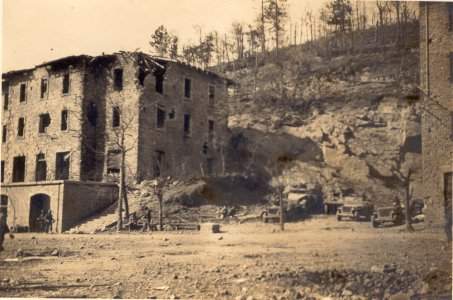
On 5th of March, FEB entered Castelnuovo. During this period, the Offensive for Spring was being prepared by the High Staff of Gen. Crittenberger and the Brazilian High Command. This was a large scale operation (which would endure till the last days of the War), ranging from the Adriatic to the Tirrene, using every single Division of every Army taking part in the campaign. The actions would start with a frontal attack on the enemy lines, and the city of Montese was the target to the Brazilian troops, so as to remove what was left of the German artillery, still causing great damage to the Allies. The city was taken, but late at night, the Germans counter attacked and it took a high number of casualties to finish off with the fight, again, a tough and bloody page in the actions of FEB during the Italian Campaign.
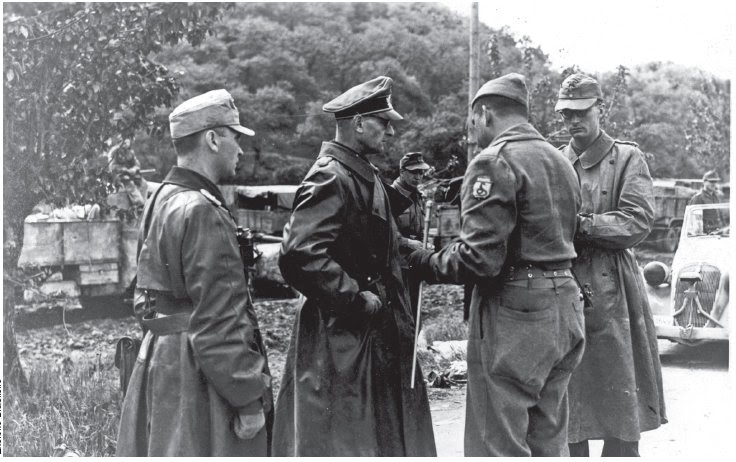
German militaries of 148th Infantry Division of surrender to Brazilians soldiers on April 28, 1945 near the city of Fornovo. By that time it was commanded by General Otto Fretter-Pico and had some 9,000 soldiers. Despite the still strong manpower, and the fact that it had more than 100 mortars and cannons , the division was by this time very low on ammunition and supplies.
At this point, the Germans were trying to regroup after escaping through road 64, the only path down the Appenines. The progress of the troops was fast and in a few days, the city of Parma was taken. Later on, FEB entered Bologne without any resistance. In the end of April, the actions of pursuing the enemy became the main occupation of the Allied Forces. So it was that FEB entered Collechio, still under German artillery. After surrendering a large number of Germans, the Brazilian Forces were preparing to face fierce resistance at the river Taro, from what was left of the retreating German Forces , this time through route 62. The German troops were surrounded near Fornovo and forced to surrender. So that, the entire 148th Wehrmarcht Infantry Division, consisting altogether of more than 16 thousand(!) men, including the 80th Panzer division, several Italian divisions and more than a thousand vehicles(!), surrendered to the Brazilian Forces on 28th April.
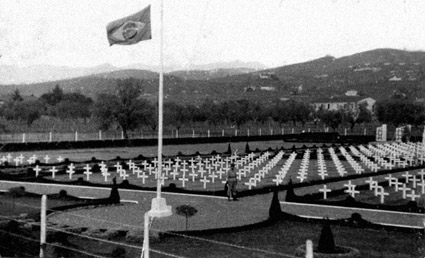
The Brazilian cemetery in the Italian city of Pistoia
On 2nd May, Brazilian Forces entered the city of Turin, in the Northeast of Italy, meeting French Mountain troops in the frontier, while in the North, FEB was on the heels of German Forces still on the run. At this date, the astounding news that Hitler was dead put an end to the fights in Italy. All German troops finally surrendered to the Allies in the following hours.
WAR IS OVER!
During eight months of the Italian Campaign, the Brazilian Forces managed to make 20.573 Axis prisoners, being two generals, 892 officials and 19.679 privates. FEB had 443 KIA, being 13 officials. Summing up with the lives of civilians and military that were in the ships of the Brazilian Merchant Navy – sunk in the South Pacific in Brazilian waters by U boats, more losses in the Brazilian Navy and Air Force, the Second World War stole the lives of nearly 2.000 Brazilians.
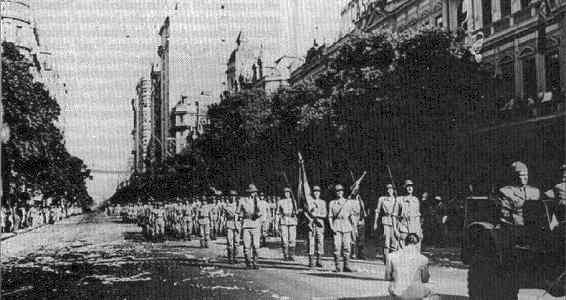
The victory parade in Rio de Janeiro
The 443 soldiers buried in the FEB cemetery in Pistoia were later removed to the WW II mausoleum and monument built in Rio de Janeiro, in the beginning of the 60’s, where stands the eternal flame lit in the tomb of the Unknown Soldier.
THE BRAZILIAN AIR FORCE – FAB
The FAB had a group of pilots and land personel trainned in the United States, the 1º GAvCA (1st Fighter Group), sent to Italy and alocated in the 350th U.S. Army Air Force Fighter Group.
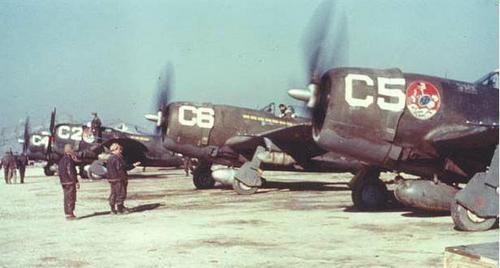
Aircrafts Republic P-47 Thunderbolt, belonging to the Brazilian Air Force who fought in the skies over Italy
The Brazilian pilots actually formed one of the 20 squadrons of the XXII Air Tactic Command, flying the updated P-47D. Their role was very important to the actions of all Allied forces in Italy and the Brazilian pilots were also very praised for their important air-to-ground operations. Many pilots were victims of heavy flack, some were downed , captured by Germans and taken to prisioner camps in Germany…

 TOK de HISTÓRIA - ROSTAND MEDEIROS